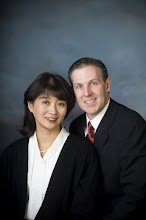
Elders and Sisters,
This year has gotten off to a wonderful start. January and February saw record numbers of convert baptisms and increases in most of our key indicators. This past month, we were also especially blessed to have Elder Quentin L. Cook of the Quorum of the Twelve and Sister Cook visit our mission. What a blessing it was to have an apostle personally visit, speak and shake hands with every missionary in the mission.
We were taught many things by Elder and Sister Cook while they were here. At the conclusion of our mission conference, Elder Cook said to me, “I was planning to teach about the Doctrine of Christ and then transitioning into commitments. But I felt impressed to change my plan and talk about these other things.” The following is a summary of a few or the things he taught us.
Love
He taught us that one important key to being a successful missionary is to love. Our mission theme teaches us this. Love is the motive! Elder Cook shared that we particularly need to love in four areas.
1) Love the People – We need to know and understand that we are all brothers and sisters. We should not be afraid to share the gospel with those we love. Loving the people is at the heart of missionary work. We show our love by serving them and helping them come unto Christ. We want to share the gospel with the people of Japan because we love them and desire their happiness.
2) Love Your Companion – We are to go forth two by two and be unified in this work. When we love our companions the Spirit will work through us. The work is not about you. As we developing the Christ-like attributes we will learn to love our companions more.
3) Love Your Mission President (and wife) – Elder Cook counseled you to love your mission president and what he teaches you. Obedience to your mission president’s counsel will bring you blessings. You were called to this mission, but you were also called to serve specifically with your mission president. You were called to a mission and to a president.
4) Love the Lord – The Savior taught, “If ye love me, keep my commandments.” This is His work. He has commanded us to “Feed His sheep.” We show the Lord our love be being righteous and by feeding His sheep.
Trust the Lord
Elder Cook read with us D&C 31. What he taught us about verse 5 stands out in my mind. He said we will be blessed for doing this work. Then he made several specific comments and promises to the missionaries based on this verse. Verse 5 says, “Thrust in your sickle…” and “Wherefore your families shall live.” He promised each of you as an Apostle of the Lord, that this scripture would be fulfilled.
Specifically he said:
- You are doing now what you should be doing and you are where you should be.
- Your service will bless your loved ones.
- Everyone you love and care about will be blessed now and in the future because of what you are doing now.
- Nothing is more important than what you are doing now.
As I have spoken with many of you, I know these words and promises were comforting and an answer to your prayers.
Establish the Church
He shared with us the importance of having a big vision regarding the work. He said among all the things we are doing we must establish the church here in Japan. He told each of you to do all you can to help make each ward or branch you serve in stronger. This includes finding, teaching and baptizing, but also less active work and retention as well as strengthening the youth and single adults. When your mission is over you should ask yourself, “Did I help establish the church?” Do those things now so you can answer ‘yes’ to that question.
Purify Yourselves
Referring to Section 112 of the D&C we were taught and reminded of the importance of humility and the need to purify our hearts and cleanse ourselves before the Lord. The Spirit is the key to the work and we receive the Spirit when we are worthy of it.
The Doctrine of Christ
In closing he shared some tender feelings about being called to serve as an apostle. He said he has had many special and private experiences related to his calling. Some can be shared and some cannot. He taught us that the atonement is much more than something that can bring us forgiveness of our sins. The atonement will make fair the unfairness in the world. The atonement can heal all pain and suffering. It can compensate for all the injustice in our lives. He boldly testified that Jesus Christ is our advocate with the Father. And he said he feels very strongly that the Lord feels much compassion and love for those that serve missions. He will be your advocate. As we do the best we can, His grace is sufficient to heal, save and repair whatever wrongs we experience in this life.
To his testimony I add mine. I love the Savior and know He lives and leads us today. We were truly blessed to have had one of his special witnesses with us in the Japan Kobe Mission.
May the Lord bless each of you!
President and Sister McIntyre


 The day started early in the morning with a hike up the mountain for a devotional. The Kobe and office elders also joined us for the morning. We all gathered in front of the mission home to start our hike.
 Before heading up the mountain we stopped at the Maya Cable Car station for a picture on the steps.
 Everyone enjoyed the view of Osaka and Kobe Bay and city from the mountain.
 Elder Crapo also treated us to a rendition of
  We attempted a group picture and almost got everyone looking in the right direction.


 Elder Maeda visited Kobe on his birthday to celebrate it with President McIntyre whose birthday was the same day.
 President got a face cookie too!
 The missionaries in the Kobe District decorated the office and had a small party for President McIntyre and Elder Maeda.


 The coastline is beautiful. These small towns are mainly supported by fishing. The area is very famous for crab which is in season from about December through March.

 It is very rural. This is the little one car train that runs along the coast in these parts.
 James was not watching and I had to jump in to try and save mom.


 Rika got revenge on the giant crab as she devoured several of his smaller cousins that night.


 The hotel had a great bath, nice futons and cool Japanese yukata.
 It also had a veiw of the ocean from the top floor.
 It was a short trip but a lot of fun. Japan has so many beautiful and fun places. There is also a lot of great food! We were back in Kobe by Tuesday late afternoon and it was back to work.
 At the end of WWII the port was used as a repatriation point for Japanese families who had been living in China, Manchuria and Russia during the war. One of the closest ports to Korea and China, rescue ships traveled to the port loaded with thousands of Japanese who were left destitute on foreign soil when the Japanese empire fell and surrendered to the US. This is the dock where the refugees landed and began their repatriation to Japan.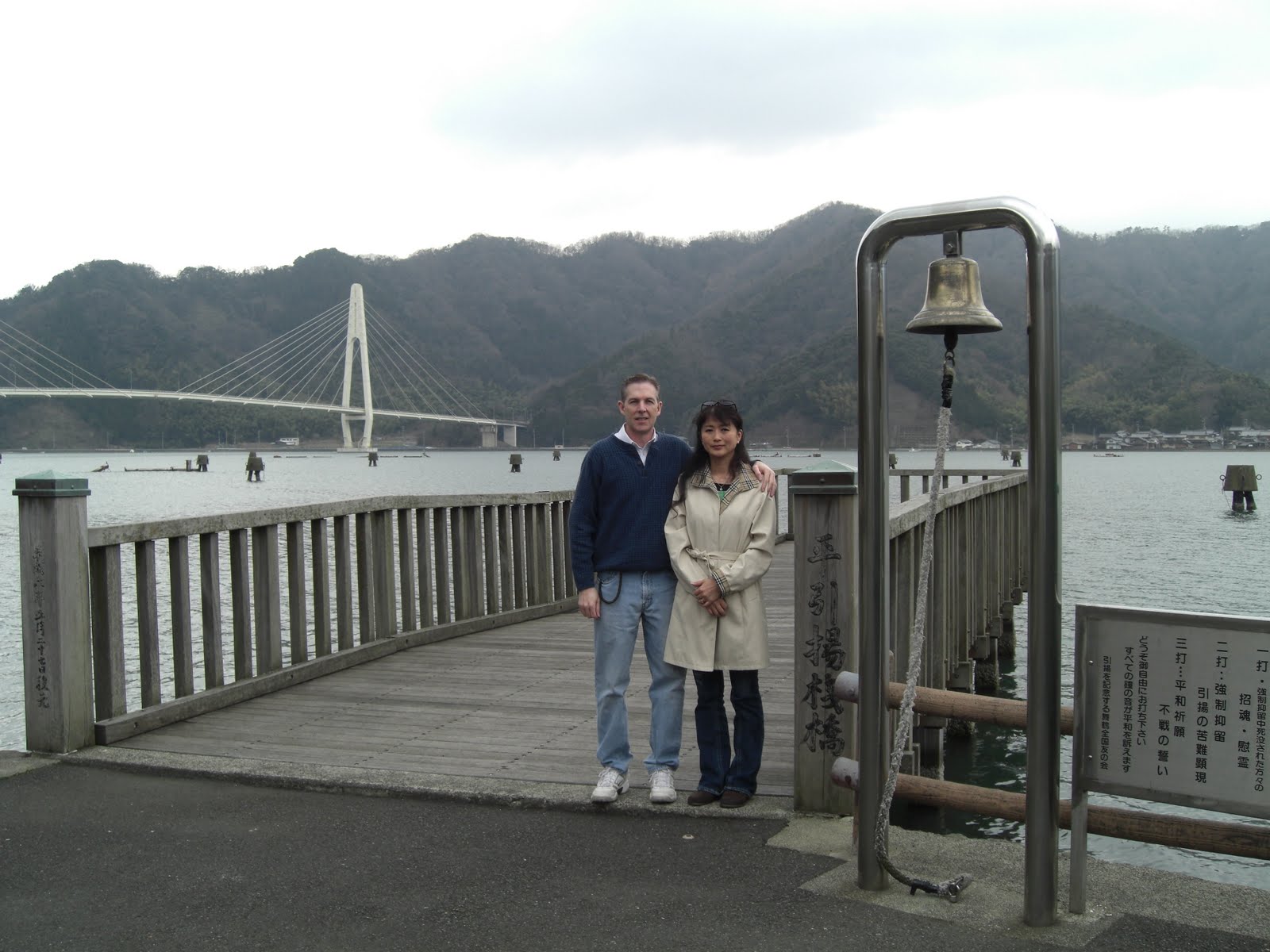
 Many Japanese woman and children perished in China waiting to be rescued. This is a monument commemorating the arrival and repatriation of these Japanese back to their country. Sister McIntyre's grandfather helped his wife and two daughters (Sister McIntyre's mother and aunt) find a rescue ship and eventually make their way back to Japan. He, unfortunately could not make the trip and died of starvation in Dalian, China. War is a terrible thing and innocent people on both sides of a conflict are hurt and affected. Certainly many Japanese soldiers did unthinkable things to the people throughout Asia as the war expanded and Japan occupied these countries. But there were also many innocent Japanese caught in the conflict.
 Observation deck overlooking Maizuru port.
 Displays at the repatriation museum in Maizuru.

 A photo of a rescue ship like the one Sister McIntyre's mother sailed on from Dalian, China to Maizuru, Japan.


 In 1986, about 5 years after Sister McIntyre's baptism, her mother joined the church in Fukushima, Japan. President McIntyre, who was a teacher at the MTC in Provo at the time, was the teacher that taught the missionaries who went to the Sendai mission and taught her the gospel and baptized her. She currently is a member of the Fukushima Ward, Sendai Stake.